


Plinko is one of the simplest casino games available and one of the fastest-growing. A ball drops through a peg board, lands in a multiplier slot at the bottom, and pays that multiplier on your stake. There are no paylines, no reels, no feature rounds to wait for. The only meaningful decision you make is the risk level — which determines how the multipliers are distributed and how violently the outcomes swing.
This review explains how the ball-drop mechanic and multiplier system actually work, what each risk level does in practice, how to think about bankroll for a game with no free spins gating, and where Plinko sits relative to Aviator and traditional slots for players trying to decide between game formats.


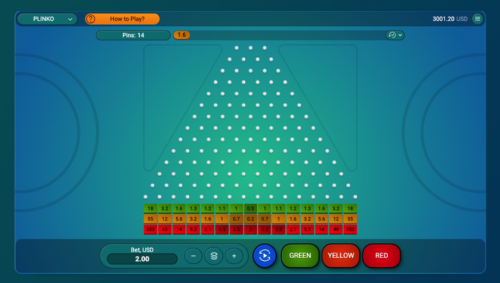
Plinko is about as simple as gambling gets, and that simplicity is the entire pitch. The board is a triangular grid of pegs; you place a bet and a ball drops from the top. Every peg it hits deflects it left or right at random until it settles into one of the multiplier slots along the bottom, and your stake is multiplied by whatever it lands on.
The multipliers aren't spread evenly. The lowest ones sit in the middle of the bottom row, which is also where most balls land; values rise toward the edges, and the highest multipliers are in the two outermost slots. The exact values at each position depend on the risk level and the number of rows you pick.
Everything else is automated. There is no timing decision, no cashout judgement, no bonus trigger to wait for. Each drop is an independent event; the previous ball's path has no influence on the next one. The RNG determines each deflection as it happens.
| Mechanic | Ball-drop through peg board; lands in multiplier slot |
| RTP | Typically 97–99% depending on casino and implementation |
| Risk settings | Low / Medium / High — each reshapes the multiplier distribution |
| Rows | Usually 8–16 adjustable rows (more rows = higher edge multipliers that are harder to reach) |
| Max win | Varies by implementation — can reach 1,000× or higher on high risk |
| Result speed | Under 5 seconds per drop — among the fastest casino game formats |
The risk level is the most consequential player decision in Plinko, and it's the parameter that most directly maps to what players think of as volatility in slots. Here's what each setting actually does:
| Risk level | Multiplier distribution | Session feel |
| Low | Middle slots pay 1×–2×; outer slots slightly higher. Tight range, little variance. | Frequent returns near your stake. Slow erosion over time. Good for understanding the mechanic without bankroll stress. |
| Medium | Middle at 0.5×–1×; outer slots at 3×–5×; corners at 10×–20×. More spread. | Regular small losses, occasional meaningful wins. The most played setting in practice — enough activity to sustain interest. |
| High | Middle at 0.2×–0.5×; corners at 50×–500×+. Most drops lose; rare outer landings win large. | High-volatility experience. Most drops return a fraction of the stake; rare corner landings can produce exceptional payouts. Similar feel to high-volatility slots without the bonus trigger cycle. |
The number of rows also matters. With more rows the ball hits more pegs, a bigger share of drops ends near the middle, and the outer slots get harder to reach. The edge multipliers rise to make up for it, so the range of results gets wider even though most balls still land in the centre. At 16 rows on high risk, the probability of landing a corner multiplier is very low; the multiplier at that corner is correspondingly very high. At 8 rows on high risk, the corners are more reachable but the multipliers are lower. This relationship between rows and distribution is what makes Plinko more configurable than most casino games.
Plinko's RTP varies by implementation, but most reputable casino versions run between 97% and 99% — notably higher than most slots. This is achievable because the game has no complex bonus features to fund; the house edge is applied directly to the payout multipliers. A version with 97% RTP has a house edge of 3%; the multipliers are calibrated so that the sum of expected values across all positions returns 97 cents per bet wagered.
Many Plinko implementations are provably fair — the randomness is verifiable through cryptographic hashes, similar to Aviator's provably fair system. This is a higher transparency standard than standard RNG slots. Where it's available, the provability applies to each individual ball drop.
One important note: RTP varies significantly between casino implementations of Plinko. Some versions run 99%; others as low as 95%. The same visual game can have materially different RTPs at different operators. Check the game info at your specific casino before playing for real money — unlike most slots where the RTP is set by the game developer, Plinko's RTP can be operator-configured.
Both Plinko and Aviator are often described as "crash games" by players, though Plinko is technically a drop game. The comparison is worth making directly because players choosing between instant-result formats often consider both.
Aviator requires a timing decision — you watch a multiplier climb and decide when to cash out before the plane flies away. The decision point is Aviator's defining experience: when to exit. Auto-cashout removes this, but the timing element is why people play it manually. Plinko has no decision after the ball drops. You watch the result passively. There's no tension of a climbing multiplier; there's just the path of the ball.
Aviator has a fixed RTP published by Spribe (97%). Plinko's RTP is operator-variable. Aviator is always high volatility; Plinko's volatility is controlled by your risk setting. For players who want agency over their variance profile without a timing decision, Plinko is the better tool. For players who enjoy the tension of the Aviator cash-out decision, Plinko's passive result is a different kind of game.
Traditional slots have reel symbols, paylines or clusters, bonus features, and varying triggers for those features. The structure creates a game within a game: there's the base game (where you wait for something to happen) and the bonus (where the main value is generated). Plinko has none of that structure — every drop is its own complete event with an immediate result. There's no waiting for a scatter trigger, no free spins round, no expanding symbol.
For players who find the base-game-to-bonus structure of slots unsatisfying — particularly the waiting — Plinko is a direct alternative. Sessions have continuous activity: every drop is a result. The tradeoff is that there's no escalating event to look forward to. The session experience is more uniform than a slot with a significant bonus round.
Plinko's simple visual format makes it particularly well-suited to mobile. The peg board renders clearly on any phone screen, the ball path is easy to follow, and the multiplier slots at the bottom are readable without zooming. Each drop takes under five seconds, which suits mobile data connections and short-session play. No feature differences between mobile and desktop.
Most casinos put Plinko in their instant-win or crash section, and several studios make their own version. Which version a casino carries, if any, depends on its provider deals, so search the lobby before you deposit and verify the active RTP there.
Plinko sits in the instant-win section, and each casino chooses its own version, so a casino on this list may not carry it or may run a different one. Magnetic Slots, Boomerangbet and Rolletto hold Curaçao licences, BetiBet cites a Tobique licence in its terms, and Baloobet has a Costa Rica business registration but no gaming licence. Always confirm the active RTP at your casino, as Plinko's return rate can vary significantly between operators.
2
Boomerangbet

Welcome bonus
€1,000 + up to 300 Free Spins
3
Rolletto

Welcome bonus
150% up to €1,500 Sports
4
Baloobet

Welcome bonus
375% up to 4,000 EUR + 675 Free Spins